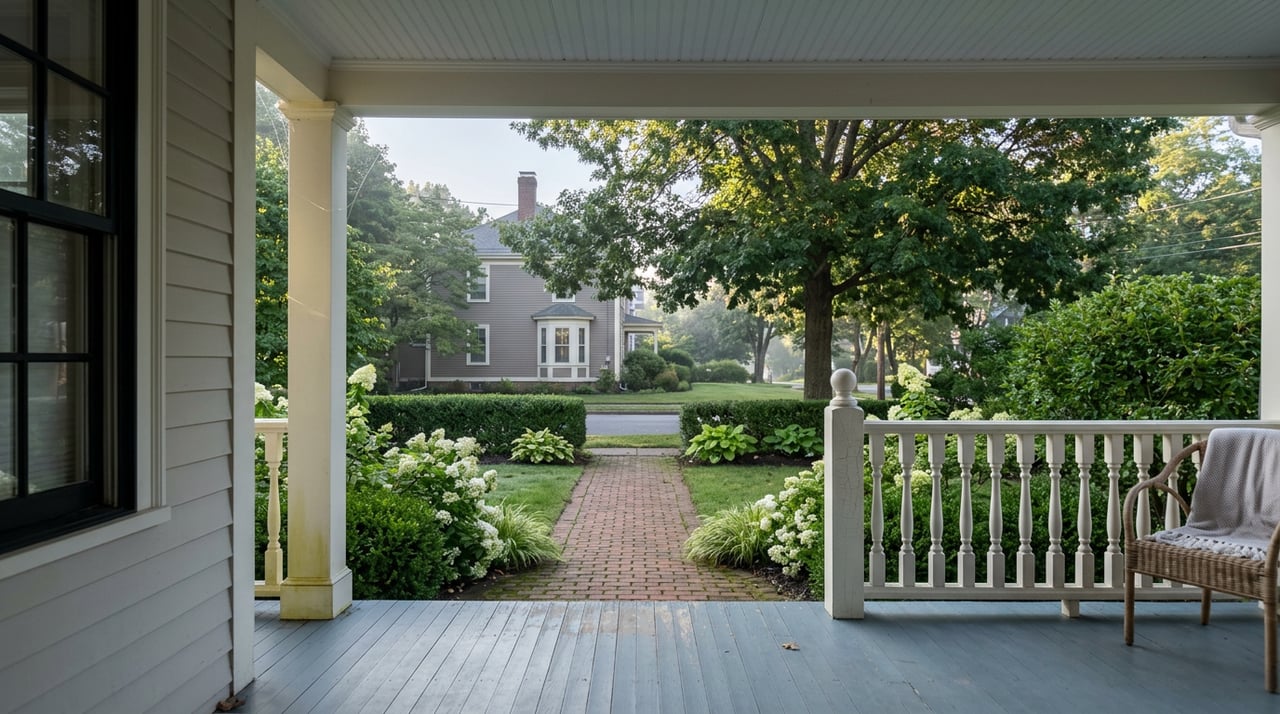
Stand at the corner of Hope Street and Blackstone Boulevard on a Saturday morning and you can watch the neighborhood's whole week fold into one intersection. The farmers market sets up in Lippitt Park. The runners and dog walkers peel off onto the boulevard's tree-lined median for the loop they've done a hundred times. Coffee gets bought at Seven Stars before anyone commits to a tomato. It looks like it always looks.
Except this year, there is another timeline running alongside the familiar Saturday routine.
The first clock is the market season, and it has a date stamped on it. The second clock started in July, when a sinkhole opened at Blackstone Boulevard and Irving Avenue during a summer thunderstorm, and the city has not put a date on when it ends.
The Market's Clock Is Fixed
The Hope Street Farmers Market runs Saturdays from 9 a.m. to 1 p.m. at Lippitt Park, the six-acre triangle where Hope Street meets the top end of Blackstone Boulevard. It is a farmer-run cooperative, meaning the people selling you cheese, seafood, and pasture-raised eggs on a given Saturday are largely the people who raised or made them. At the southern end of the same park, the Providence Artisans Market runs its own hours, 9 a.m. to 2 p.m., through the end of October. Two markets, one park, slightly staggered hours, a habit most regulars have already sorted out without thinking about it.
Both close for the season on the same date: October 31. As of this week, that leaves seven more Saturdays. Here is what's left, in case your calendar hasn't caught up to how close the end of the month actually is:
| Saturday | Farmers Market (Lippitt Park, north end) | Artisans Market (Lippitt Park, south end) |
|---|---|---|
| Sept 19 | 9 a.m. – 1 p.m. | 9 a.m. – 2 p.m. |
| Sept 26 | 9 a.m. – 1 p.m. | 9 a.m. – 2 p.m. |
| Oct 3 | 9 a.m. – 1 p.m. | 9 a.m. – 2 p.m. |
| Oct 10 | 9 a.m. – 1 p.m. | 9 a.m. – 2 p.m. |
| Oct 17 | 9 a.m. – 1 p.m. | 9 a.m. – 2 p.m. |
| Oct 24 | 9 a.m. – 1 p.m. | 9 a.m. – 2 p.m. |
| Oct 31 | 9 a.m. – 1 p.m. (final day) | 9 a.m. – 2 p.m. (final day) |
Seven Saturdays is not a lot. If you have been meaning to make the market part of your routine and haven't yet, this is the stretch where that decision actually matters, because after the 31st the corner goes quiet until spring.
The Boulevard's Clock Isn't
The second countdown is less tidy. WPRI reported that in late July, a stretch of Blackstone Boulevard at Irving Avenue was already torn up for a water and sewer infrastructure project when a line of severe thunderstorms moved through the state. The ground gave way. A sinkhole opened at the intersection, large enough that Providence Mayor Brett Smiley came to the scene that night and again the following afternoon. City crews stabilized and covered the hole within a day, and work resumed on the underlying sewer project soon after.
What has not been resolved, at least not in anything I could confirm, is when the intersection goes back to normal. The most recent public reporting on the closure has the contractor asking to keep it shut continuously rather than reopening it between work phases, on the reasoning that repeated openings and closures would slow the project down. That is a defensible position for a contractor. It is also a detail that can be easy to miss after the initial news coverage moves on, so regulars who heard about the sinkhole in July may want to check whether the detour is still in place.
The intersection sits at the start of the boulevard's signature 4.64-mile loop, the same stretch that's listed on the National Register of Historic Places and draws walkers, runners, and cyclists along its dedicated bike path most days of the year. If your usual route starts or passes through Irving Avenue, it's worth a look before you assume the detour is over. The market has an end date you can circle. The construction, as far as the public record shows, does not yet.
The Corner Itself Has Changed a Little
Set the two clocks aside for a second, because the block around them has shifted this year too, in ways that are easy to miss if your Saturday routine is on autopilot.
The most visible change is at 771 Hope Street, previously home to KG Kitchen Bar, now home to Ciao Ciao. The restaurant opened this spring under Adam Stabile, a bartender with three decades in Rhode Island hospitality, including years behind the bar at Providence Oyster Bar and a stint running the lobby bar at the Spring House Hotel on Block Island. His pitch for the space borrows from Italian aperitivo culture: a relaxed after-work stop for a drink and a small plate rather than a full sit-down commitment. It has now had a full summer to settle into the corridor rather than announce itself, which is usually when a new restaurant either becomes a fixture or fades into being just another option.
The rest of the block hasn't needed reinventing. Blooming Blossoms Floral Boutique, run by Pam, has been part of the Providence floral scene for more than thirty years, having moved from Thayer Street to Hope Street along the way. Green River Silver Co., established in 1990, remains one of Rhode Island's larger importers of fine sterling jewelry. Between the new arrival and the long-standing shops, Hope Street's commercial mix this fall looks like a corridor adding to itself rather than replacing itself, which is a distinction worth noticing if you've lived here long enough to remember when a storefront going dark felt like a loss rather than an opening.
Two Doors Most Residents Walk Past
A short detour off the main strip rewards the kind of person who has lived here for years and never quite made time for it.
At Billy Taylor Park on Cypress Street, a community mural traces a timeline of Providence's role in American music history, centered on the former Celebrity Club, one of the first integrated jazz clubs in New England. The club hosted Etta James, Ella Fitzgerald, Sammy Davis Jr., and Ray Charles in its day. If you've driven past the mural a hundred times without stopping to read it, the seven remaining Saturdays of market season are as good a window as any to finally park the car and walk over.
At the corner of Hope and Doyle, Ladd Observatory is part of Brown University's Department of Physics and a museum listed on the National Register of Historic Places. It opens to the public every Monday evening starting at 7 p.m. It is the kind of neighborhood asset that out-of-town guests find more interesting than residents ever do, mostly because residents assume they'll get around to it eventually.
Why the Contrast Matters More Than Either Fact Alone
None of this is really about a restaurant or a mural or a market schedule taken one at a time. It's about what it means to live somewhere long enough that you stop noticing the systems that make a Saturday feel like a Saturday, until one of those systems runs on a different clock than you expected.
The market's rhythm is dependable because it's designed to be. Same park, same hours, same end date every year, which is exactly why it's easy to take for granted until the calendar tells you there are only seven Saturdays left. The boulevard's rhythm got interrupted by something nobody planned for, and the timeline for getting back to normal is genuinely less certain than most people assume. Living here well, at least for the next few weeks, means checking both.
That's the same instinct worth bringing to almost anything about this neighborhood, whether it's a farmers market closing date or a house you've watched for years wondering what it might be worth. In either case, the details are worth checking.
If you're weighing a move within the East Side, or just curious what a specific block or corridor looks like from someone who tracks these details as a matter of course, Lisa Ardente would be glad to talk it through. Let's Connect.
